

Introducing the 2025 Cohort
13 Mari: Drastic hull drag and fuel consumption reduction with science inspired by nature
With fuel costs representing 50-75% of total ship operating expenses, and prices continuing to climb, the maritime industry faces significant financial pressure. Adding to this challenge are the mandatory measures imposed by the International Maritime Organization (IMO) to reduce greenhouse gas emissions from international shipping, including the MARPOL treaty, the Energy Efficiency Design Index (EEDI), and the Ship Energy Efficiency Management Plan (SEEMP).
13 Mari offers an innovative solution to address both these issues. Their simple composite element, designed to reduce “drag” – the resistance a vessel experiences while moving through water – can be installed on a ship’s hull without compromising its integrity. Installing 15-30 of these relatively small, “shell-like” elements can reduce drag by up to 7%, directly translating to a 7% saving in fuel and a 3-5% reduction in overall operating expenses.
Currently, 13 Mari’s solution can cover a portion of the hull, with individual elements capable of achieving up to a 20% drag reduction. The company anticipates future advancements will allow for even greater reductions. 13 Mari estimates that the current MVP (Minimum Viable Product) of their solution can eliminate 45 million tons of CO2 annually, making it a powerful tool for both financial savings and environmental sustainability.
PortXL interviewed founder and chief-scientist, Krassi Fotev.
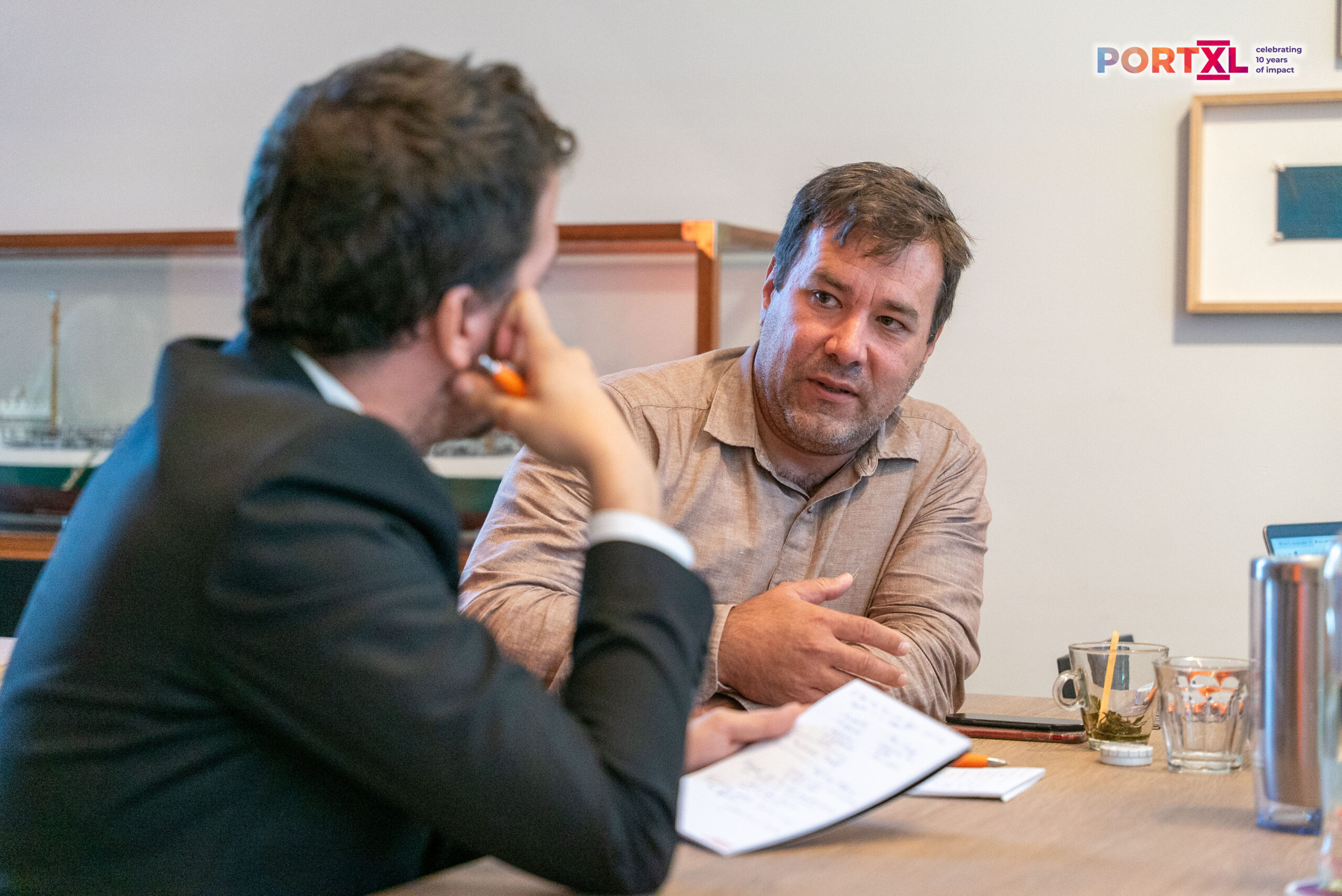
Krassi Fotev, Founder & CEO & Chief Scientist 13 Mari
Rumor has it that the idea for this novel technology came to you on the beach, during vacation. Can you revisit that moment and tell the readers about it? What specific natural creature was the most inspiring? Would you describe it as a classic eureka moment?
Yes, this is true; it happened at Lac Bay on Bonaire. There was a very windy day with the wind coming from SW rather than the usual NW. The following day very well-formed two-dimensional ripples appeared on the bed of the bay, with adjusted orientation. This caught my attention, as the ripples were everywhere around me, created by a current associated with the change in wind direction. Because of the widespread occurrence of well-formed ripples, I began to think that the ripples likely work together with the flow on top, keeping the entire system in a low energetic state – this from the high-level principle of least action perspective I decided to document the geometry of the ripples — I probably still have a picture on my old phone. Since I was on vacation with family and friends, nothing more got done during this Bonaire trip.
Can you share with us the period following the initial idea? How did the research and prototyping phase unfold?
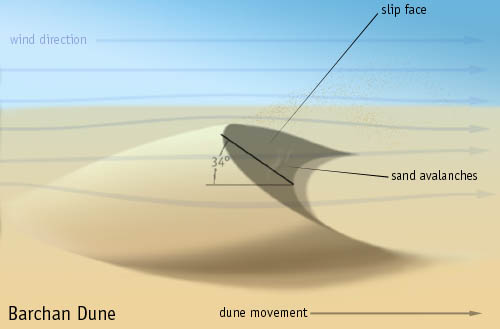 I wanted to know whether the initial theory was valid and whether the ripples improve the flow efficiency. I went online and started reading peer-reviewed articles related to dunes. In the process, I learned that ripples are an intermediate stage along the route to barchan-type 3D dune forms.
While there were studies on the fluid flow atop a barchan dune, none of them suggested that the dunes can assist the flow or lead to drag reduction. The majority of the studies I found focused on 2D fluid flow, which I thought was somewhat detached from reality, so I continued the research. Then there were the Mars dunes articles from 2012, as the discovery of dunes on the surface of Mars renewed interest in them. These photographs, at a later stage, assisted in perfecting the shape 13 Mari settled on in the early days.
For the experimental validation, both computational and physical, progress was slow, as I worked on this part-time in parallel with consulting for Credit Suisse’s Structured Products Group, with everything self-funded. These self-funded activities amounted to about USD 200,000 out of pocket by the end of 2024.
Finding partners was tedious. A UK manufacturer of flume tanks connected me with a professor at Rutgers, as Rutgers had recently purchased a new flume channel for research. The meeting at Rutgers did not go well, as the professor, I felt, had a strong impulse to hit me on the head with a thick fluid dynamics book from the 1980s, clearly stating that the turbulent flow regime – the workings of the elements – will always increase drag.
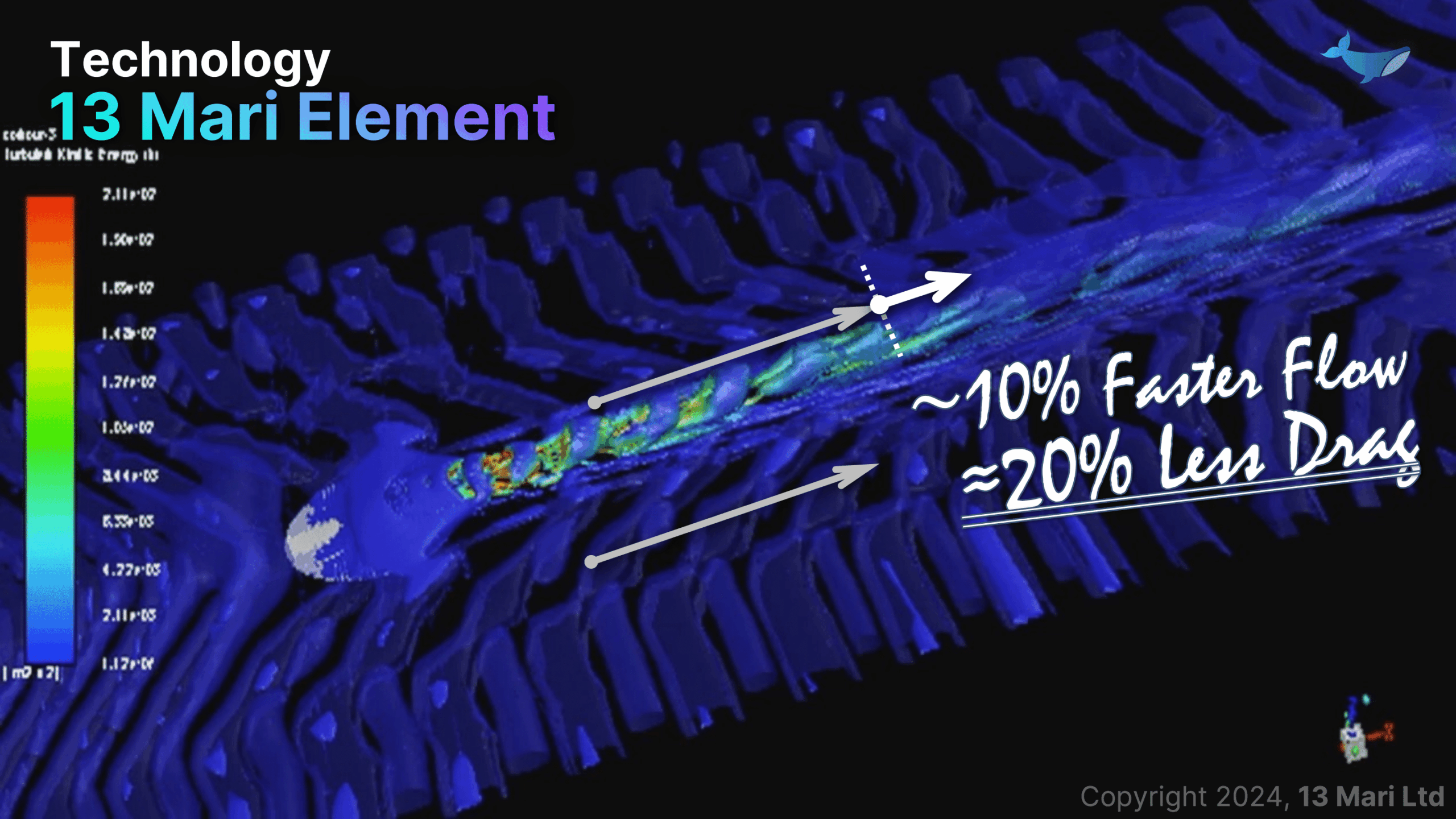 Then, a high-school classmate of mine mentioned the Bulgarian Ship Hydrodynamics Centre (BSHC) in Varna, as his PhD professor had been the head of the department. With the very limited funds available, and the project being completely self-funded, I began wondering how to make an international phone call with a budget plan that does not allow foreign calls… Though imperfect, the solution was Viber. In a brief conversation with Prof. Dr. Kishev, I explained what I was after. He arranged for an in-person meeting with his deputy, Prof. Milanov. Prof. Dr. Kishev agreed to start with computational fluid dynamics (CFD) validation work on or around the second half of December. The first simulation showed increased mass transport along the centerline, where the vorticity structures induced by the element are located. This flow results from about 20% less drag on the centerline. The movie showing the flow depicted in turbulence intensity is now permanently present on a slide in the 13 Mari pitch deck.
I am incredibly grateful to Ognyan for his support, to Prof. Dr. Rumen Kishev for taking on the project, to Prof. Milanov for validating the project’s merits, and to Grigor Nikolov, PhD, for carefully conducting the initial CFD studies with the appropriate turbulent models. Now that I know a bit more about CFD, I realize how fortunate we were to observe drag reduction with CFD using the first-ever 13 Mari element design.
Because of this CFD result, BSHC reserved towing tank slot time at a low rate for us. This is how the experimental work began.
Can you describe what a flowsmart element looks like? What does it resemble, and how is it inspired from nature?
There are two element shapes from a section of eight or ten. One is modeled after a barchan dune, and we are on a second iteration of the element design. The images from Mars, which capture the evolution of the barchan dunes undisturbed across the Martian surface, were invaluable for the design of the second-generation element. This second design eliminates the flow instabilities we had observed in the first-generation element simulations. It is highly efficient, for its size, at generating the coherent structures we observe to be associated with drag reduction. However, it has a shortcoming: sensitivity to flow direction. A slight misalignment between the flow and the axis of symmetry leads to poor performance. While a third generation of the element is under development, we settled on a different element shape for the initial practical implementations.
The element we settled on is modeled after a humpback whale tubercle. Though less efficient than the dune modeled one, with radial symmetry, it can handle a multimodal flow, exactly what we need for implementations in the vessel’s bow.
In both cases, the element shapes have been modeled after existing natural structures. In both cases, drag reduction was achieved. This cannot be said of man-made shapes we tried, such as ramps or wedges.
How many ships have been so far equipped with Flowsmart elements?
We were extremely fortunate to receive the initial commercial orders from two ship-owning companies, which understand the experimental nature of the solution. We installed 13 Mari on the most fuel-efficient container carrier design in the first fleet. In the second fleet, we installed two chemical tankers in perfect condition. In all three cases the product installed was in the form of a retrofit.
In November, we are installing a fourth vessel, a new build this time. The new vessel will undergo a sea trial with the 13 Mari elements on the hull before being delivered to the vessel owner. With the class present on board, we cannot express how excited we are about the opportunity to receive a class statement about the observed effect of the 13 Mari elements. As everybody understands the difficulties and the need for more product refinements, the vessel builder and owner reserve a few new builds for iterations, until we arrive at the savings measured in the towing tank.
What do you wish to achieve with the PortXL acceleration program?
 13 Mari is looking to diversify in multiple ways: we wish to achieve commercial traction in Europe. It only makes sense, as the majority of the research and commercial engagements for other parts of the world are handled at R&D facilities in Europe. Despite the optimizations physically happening in Europe, we do not have confirmed European vessels, apart from Ireland, in the pipeline; further more we also want to engage with European investors for the first equity fundraising, scheduled for the Q3-Q4 of 2026, and with MARIN and technical universities in the Netherlands as part of the 13 Mari R&D program.
How do you find the Rotterdam startup ecosystem?
Despite the challenges from a tax perspective, there is a healthy Maritime ecosystem. It will be great to see this ecosystem thrive as it provides the infrastructure needed for the startups to grow by gaining commercial traction with opportunities in Rotterdam. We consider 13 Mari extremely fortunate to engage with local to Rotterdam services and partners via the PortXL with goals aligned around the 13 Mari objectives for the program.


