

FibriTech (based in Poland) is an innovative industrial biotech company specializing in the bio-manufacturing of unique 3D spatial bio-materials with advanced properties. Using proprietary technology, FibriTech develops high-performance, eco-friendly solutions that address key challenges in agriculture, construction, oil spill cleanup, and environmental protection. The company’s proprietary manufacturing process enables the production of sustainable materials that replace traditional synthetic alternatives. One of the fastest-growing application areas is next-generation, peat-free growing media for automated horticultural production, developed under our FibriAgri product line.
PortXL sat down with Tomislaw Krężelewski, FibriTech’s COO for an interview.
Tomi, could you please tell us what is FibriTech’s breakthrough about?
 FibriTech has achieved a major breakthrough in bio-material technology. We have invented a material process that enables us to control the structure of natural organic fibers, expanding them across a 3D space. The final material properties can be precisely managed by adjusting the density, orientation, and type of fibers used. Our manufacturing process is both industrially scalable and economical, making it viable for mass-scale applications.
With our novel technology, we develop new, eco-friendly materials, named Fibrex, using abundant, renewable organic fibers. Our clean manufacturing process avoids deep chemical modifications, resulting in both biodegradable and recyclable materials. This allows us to offer sustainable alternatives to problematic spatial materials like mineral wool, peat, styrofoam, and other foam plastics.
Could you describe how FibriTech achieved this milestone, the breakthrough?
While many believe original ideas with broad potential are hard to find, we believe good engineering is a source of endless progress. I sought to reinvent material engineering with a focus on ecological sustainability. After years of dedicated work, it’s clear that this field offers vast opportunities for innovation across numerous companies.
How did FibriTech enter the horticulture industry?
By chance, we discovered that our novel fibrous material functions effectively as an eco-friendly growing medium in modern hydroponic systems. We are currently collaborating with leading European growers on commercial-scale trials, driven by the strong market shift toward peat-free solutions and the sustainability requirements of major retail networks.
What is FibriTech’s vision?
Our technological breakthrough establishes a material platform for a family of new bio-composite materials that are in full symbiosis with nature. We envision our production process becoming the global standard for manufacturing sustainable and biodegradable materials.
What do you want to achieve by taking part in the PortXL 2025 Acceleration Programme?
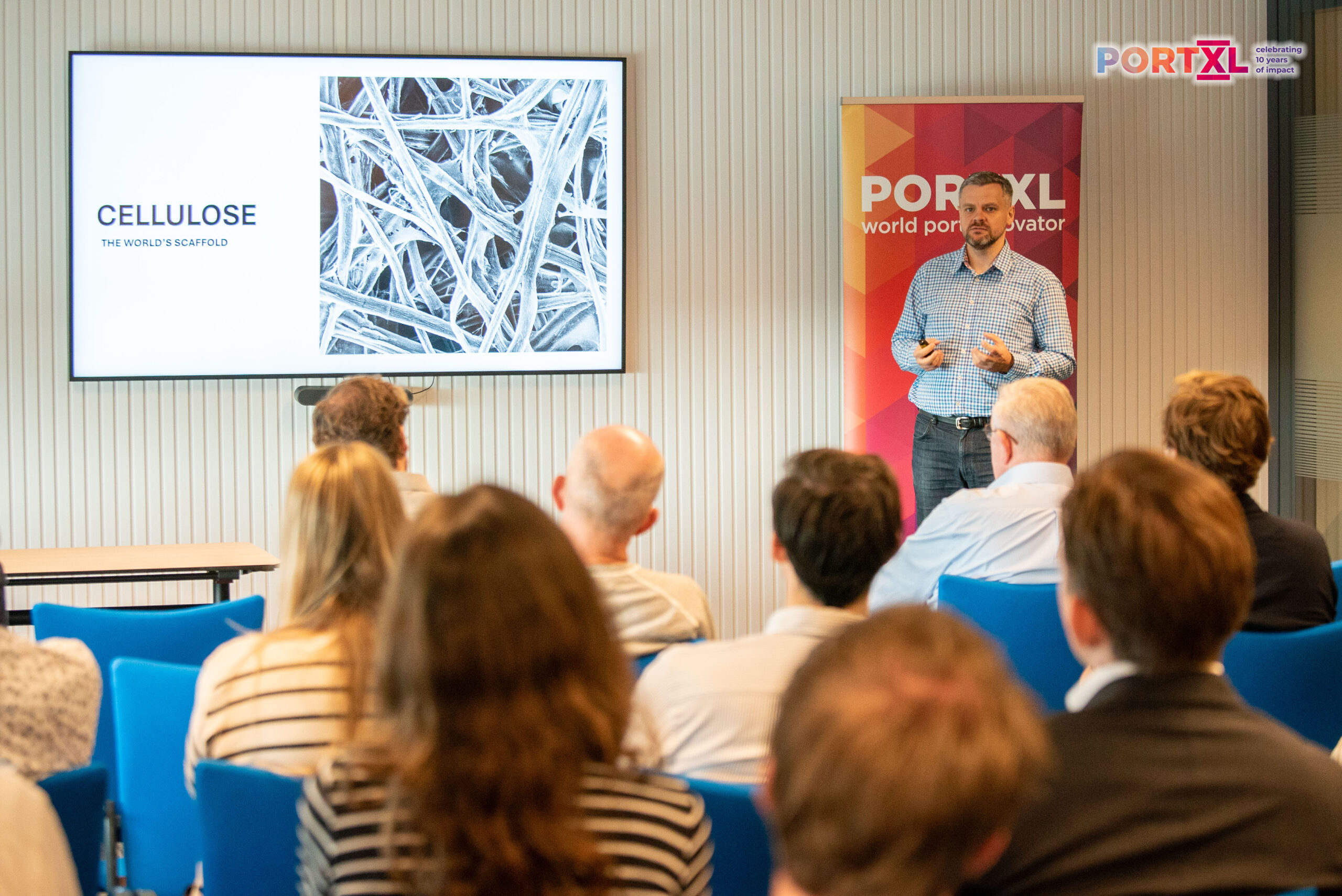 For FibriTech, PortXL is an opportunity to validate industrial applications of our materials, build strategic partnerships across sectors, and accelerate our expansion into horticulture, construction, and green infrastructure in the Netherlands.
The PortXL Acceleration Programme offers a highly refined learning experience and direct access to an exceptional network of companies, technical partners, and public institutions – a combination that significantly speeds up our market entry and technology deployment.
A standout example is our collaboration with the City of Rotterdam. Together with municipal partners and local innovation hubs, we explored the application of FibriTech bio-materials in sustainable roof-covering and green roof systems, where lightweight, biodegradable structures can improve water retention, support vegetation, enhance thermal performance, and reduce environmental impact.
An important part of this work is the potential to integrate circular biomass flows — converting locally available organic side-streams into high-value bio-materials and returning them into long-lasting, environmentally positive applications within the city.
This project highlights how Rotterdam’s ecosystem enables rapid prototyping, cross-sector cooperation, and real-world piloting within the urban environment.
How do you find the Rotterdam start-up ecosystem?
In my opinion, Rotterdam is one of Europe’s most collaborative and innovation-driven environments. What really stands out is how seamlessly different parts of the ecosystem work together — from proactive municipal authorities to engineering partners who are genuinely open to prototyping and testing new solutions, all supported by strong sustainability commitments across the city. Public–private cooperation is simply part of the local culture.
For deep-tech companies like ours, this creates an exceptionally supportive setting. It accelerates real-world testing and allows technologies originally developed as bio-materials to quickly find multiple high-value applications, from agriculture and greenhouse systems to green infrastructure and circular construction.


